What if NATO-s ‘Theory of Victory- is a recipe for disaster?
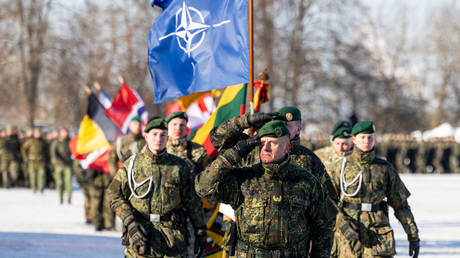
What if NATO-s ‘Theory of Victory- is a recipe for disaster?
The alliance’s race to be ready by 2029 raises a dangerous question: when does the ability to fight become the temptation to strike?
On October 5, 2026, at the Warsaw Security Forum, NATO’s Supreme Allied Commander Europe (SACEUR) Alexus Grynkewich unveiled a military strategy titled ‘Theory of Victory’.
The strategy covers the next few years and outlines NATO’s preparations to counter a potential Russian attack. While the details are likely classified, the main points have been made public. Here are the key publicly disclosed aspects of NATO’s ‘victory’ plan:
Economic exhaustion of the adversary: The development of military and industrial capabilities that would make continued hostilities costly and futile for the aggressor. Here, NATO is positioning itself as the defending party.Destruction of support infrastructure: Strikes against the enemy’s infrastructure, targeting not only the attacking forces but also the entire system sustaining the armed forces – logistics, command centers, supply lines, and reserves.2029 as the operational readiness benchmark: By 2029, the US Armed Forces and NATO’s European allies must complete the main preparations for countering potential global threats and must be ready to address any external challenge.NATO’s technological superiority: This point emphasizes achieving comprehensive technological dominance through the widespread use of drones and AI-driven combat management systems.That’s the ‘theory of victory’; now, it has to be put into practice. Certain types of political documents don’t present any interest as long as they’re stored in bureaucratic folders – no one cares about numbers, timelines, logistics, and readiness levels. But once they enter the public domain, they quickly acquire symbolic meaning. A defense plan becomes a war plan, deterrence turns into targeting, and a simple date on a calendar becomes a prophecy. This is precisely the case with this strategy. Formally, NATO’s plan doesn’t contain anything sensational: it talks about strengthening the eastern flank, preparing equipment and resources, expanding exercises, aligning industrial capabilities with evolving needs, setting readiness targets, integrating air and missile defense systems, creating logistical routes, and developing crisis response scenarios. All of this has been part of NATO’s alarmist yet necessary routine for decades. However, this time, something new has been added: a deadline!
And the deadline – 2029 – resonates not just as an administrative milestone but as a psychological turning point.The question that comes to mind is both simple and unsettling: how dangerous is it to prepare society, the military, and politics for a threat that may be driven by fear rather than grounded in reality? ‘Being prepared’ is one thing; but can it lead to the idea that ‘since we’re prepared, we can be the first to act’?
Let’s talk about the potential threat. The rhetoric, plans, and timelines all point to a specific year: 2030. Various Western ‘seers’ suggest that this is when ‘Eastern hordes’ will charge westward. In other words, Western analysts anticipate a Russian assault on NATO countries around this time. At the same time, NATO leadership candidly states that currently, the threat from Russia is assessed as minimal. But by 2030, Russia will be ready!
It’s tempting to call this the mythical Russian threat, but the term mythical has been used so often that it has lost its meaning. It seems to create a divide between those who believe in the threat and those who perceive reality. However, geopolitics rarely fits neatly into black-and-white categories. A threat can be simultaneously real, exaggerated, distorted, and dangerous, precisely because it contains a kernel of truth.
Read more In rea








 12.8c
12.8c