The worst day in Russian history: How the USSR met Hitler unprepared and still crushed him
The worst day in Russian history: How the USSR met Hitler unprepared and still crushed him
On the 85th anniversary of the Nazi invasion, a look at why the Red Army nearly broke in 1941 and why the USSR did not
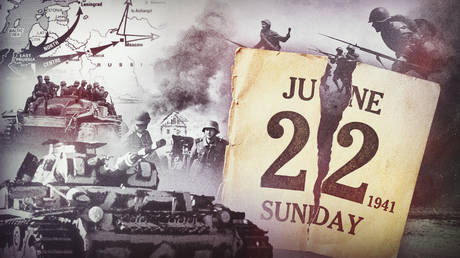
Every country has its catastrophic moment – the date that goes down in history as the nation’s darkest day. For Russia, disaster struck on June 22, 1941.
The Nazi attack on the USSR resulted in the deaths of 27 million people; around half of them were unarmed civilians – innocent victims of the war and the Nazis’ genocidal plans. The Soviet territory occupied by the Nazis during the war was the size of a country like Iran and had a pre-war population of 86 million.
It took the USSR four years to repel the attack and win, by which point many cities and regions were completely destroyed. Leningrad (now St. Petersburg), set a grim record in the war. The city wasn’t occupied by Nazi forces, but the merciless siege, bombings, and the horrific famine during the Siege of Leningrad claimed the lives of 650,000 people.
World War II, known in Russia as the Great Patriotic War, inflicted the most terrible collective trauma in the country’s modern history; the long-term consequences affect the population to this day. Most Russian families know where their ancestors fought, worked, and died during the war.
One of the most pressing questions in Russian history is how all this could have happened. Why did a country that had long prepared for war suffer such a terrible blow, and why was the army of a 200 million-strong nation forced to retreat from the Polish border all the way to Moscow and the Volga, thousands of kilometers away?
An army that showed up too late We’ll have to start from far off. The Red Army, like the other participants of the war, was influenced by former experience. However, in Russia’s case, this experience was particularly complex and dramatic.
In Russia, World War I was followed by the Russian Civil War. It lasted until 1922 and had catastrophic consequences for the entire country, including its society, industry, and the armed forces. The new army had to be built almost from scratch. A huge portion of the officer corps either died fighting in the Civil War or emigrated. Russians could be found in the most surprising corners of the world: For example, the former colonel of the Tsar’s artillery became chief of the General Staff of Paraguay after the Civil War. The problem was that these people were removed from their own armed forces. Then, several waves of political purges occurred in the Red Army, which eliminated a certain number of both old officers and new commanders who gained experience in the Red Army.
At that time, the USSR was very poor and couldn’t afford modern weapons. And weapons weren’t the only problem. In 1929, a local conflict on the border with China revealed the country’s extreme level of poverty; the equipment was worn out, and there was even a shortage of binoculars and wristwatches. Ammunition production rates were quite dismal.
Soldiers of the 1st Cavalry Army at a rally to receive the Honorary Revolutionary Red Banner from the All-Russian Central Executive Committee in 1920. © Sputnik Surprisingly, Red Army commanders had quite advanced theoretical views regarding the future war. But due to the general poverty of the population, those who remained in the army were either useless slackers or people willing to work for food just to get near a machine gun. Nevertheless, the concept of army development envisioned the creation of highly mobile mechanized units, a powerful air force, and the combined use of these forces for achieving deep, dynamic breakthroughs.
In the 1930s, industry in the Soviet Union developed at a rapid pace, and some issues were hastily resolved. However, many of the old problems remained. A severe shortage of spare parts, ammunition, and auxiliary equipment impacted the army’s ability to operate on the battlefield, since equipment was also required for t




 31.5c
31.5c